Why ADHD Brains Procrastinate: A Detailed Neuroscience Review
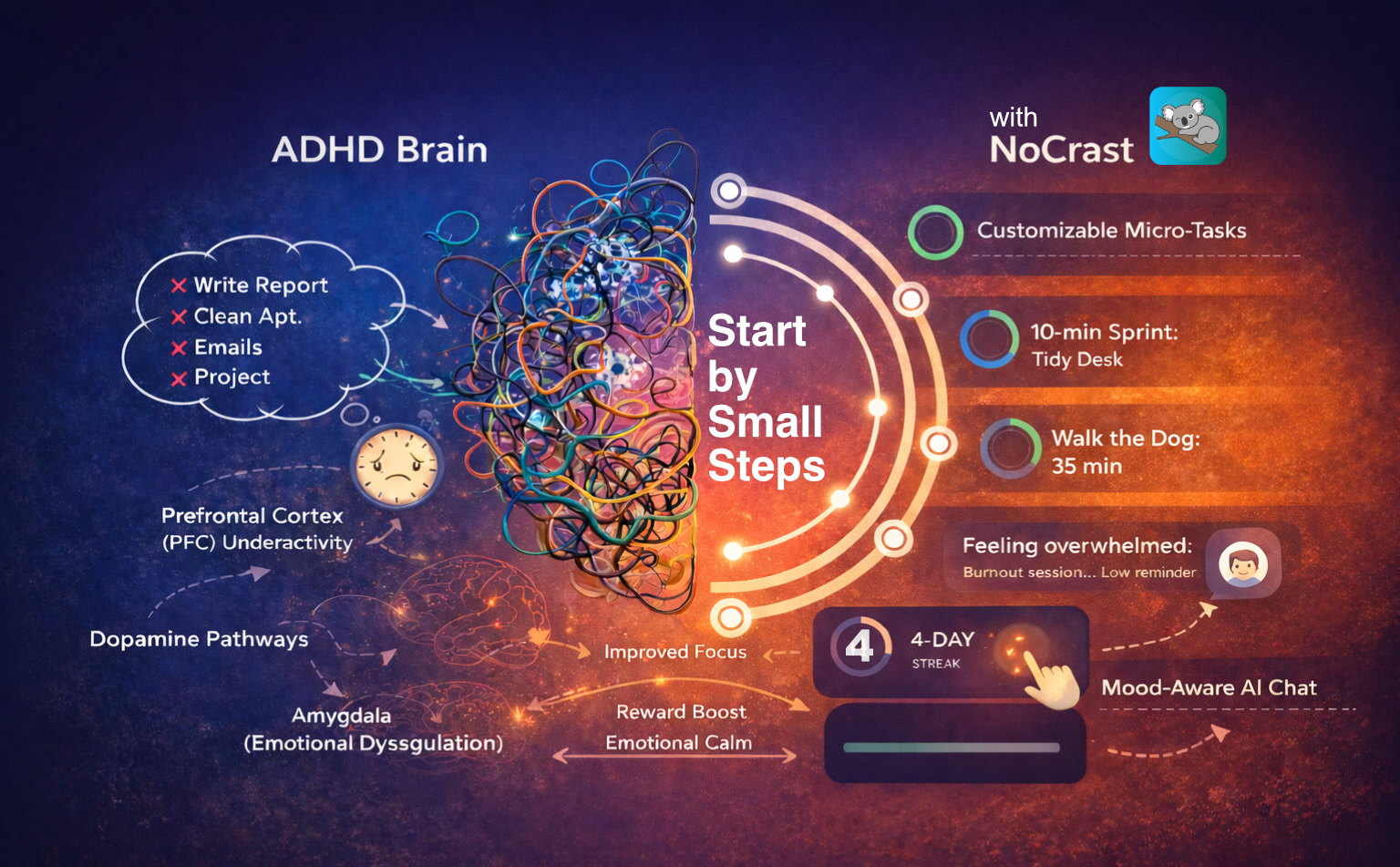
ADHD procrastination arises from disrupted brain mechanisms, not laziness. Core issues include prefrontal cortex (PFC) underactivity, dopamine pathway inefficiencies, and emotional dysregulation, all amplifying task avoidance and “I’ll do it later” behavior.[1][2][3]
Neuroscience research shows that ADHD brains struggle to coordinate planning, reward, and emotion networks, making it harder to start boring tasks, resist distractions, and regulate the emotional discomfort that comes with effort and potential failure.[4][5]
Prefrontal Cortex Dysfunction
The PFC governs executive functions like planning, impulse control, prioritization, and sustained attention. In ADHD, fMRI studies show reduced PFC activity during task initiation and weaker connectivity with control networks, making even simple starts feel overwhelming and effortful.[1][6][7]
A 2016–2025 body of work links this to lateral PFC (lPFC) recruitment failures and default mode network (DMN) dominance: when a task should engage “focus mode,” the brain drifts into mind-wandering instead, especially in people who chronically procrastinate.[8][9][9]
How NoCrast Helps PFC Underactivity
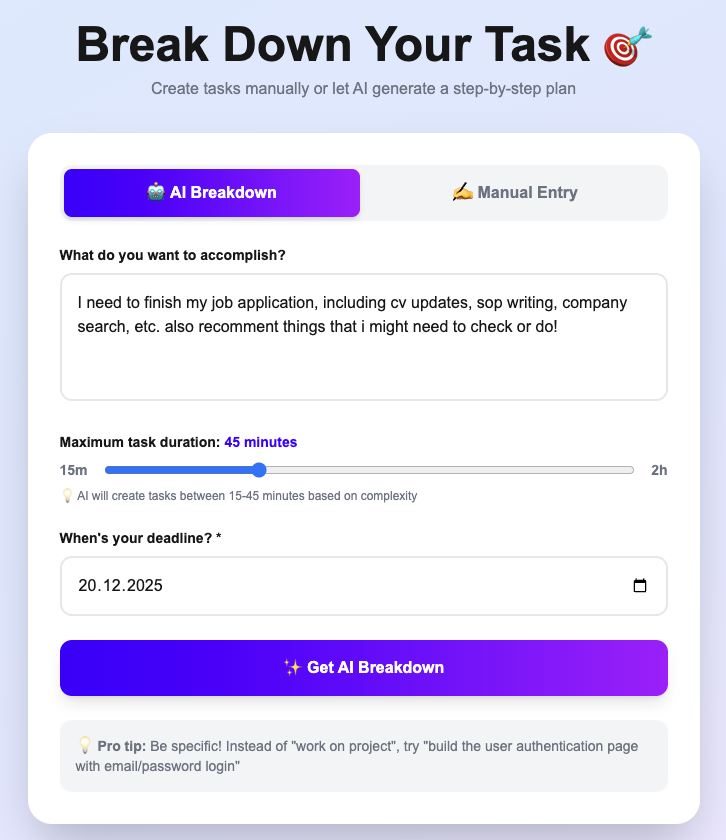
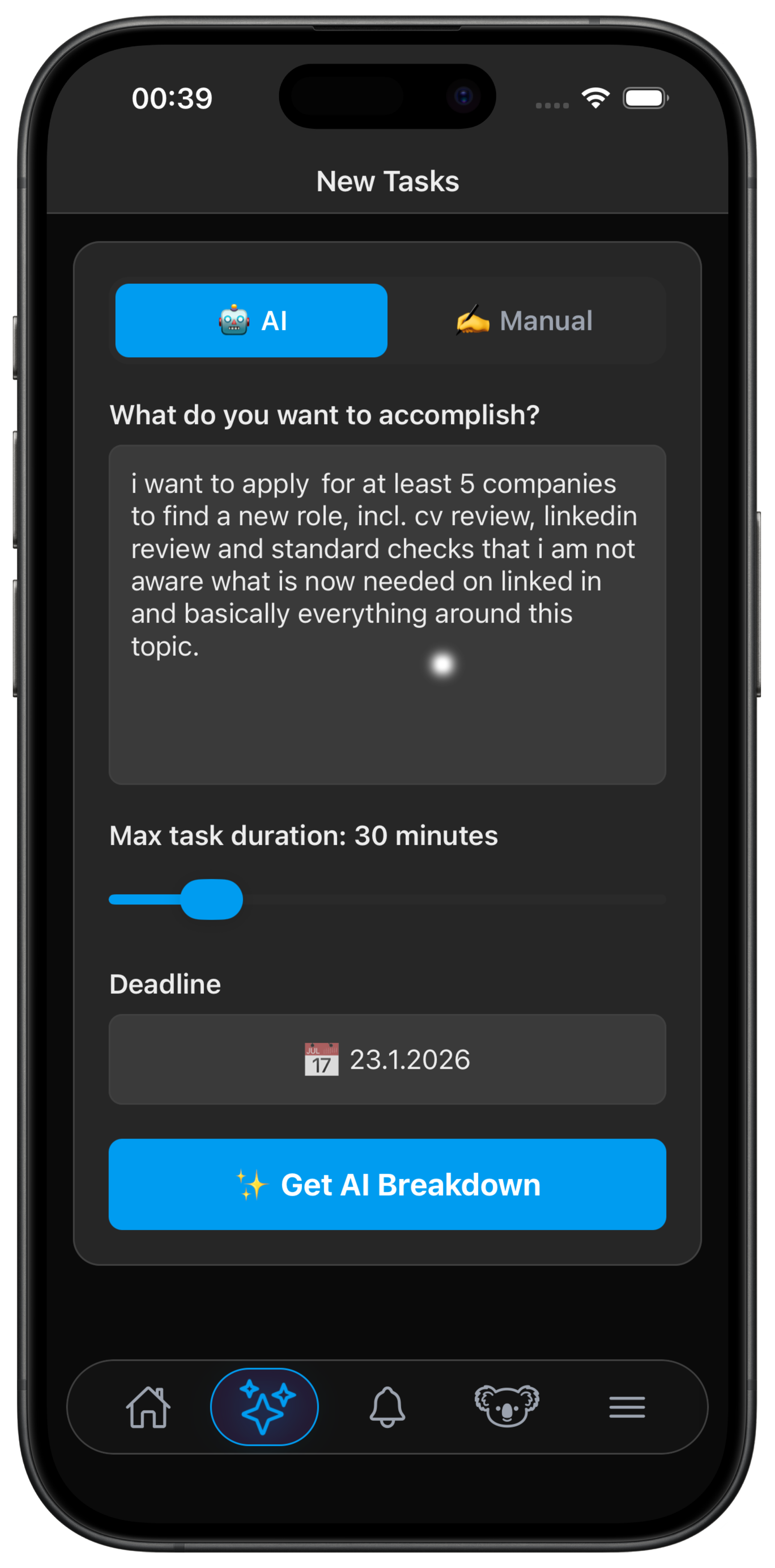
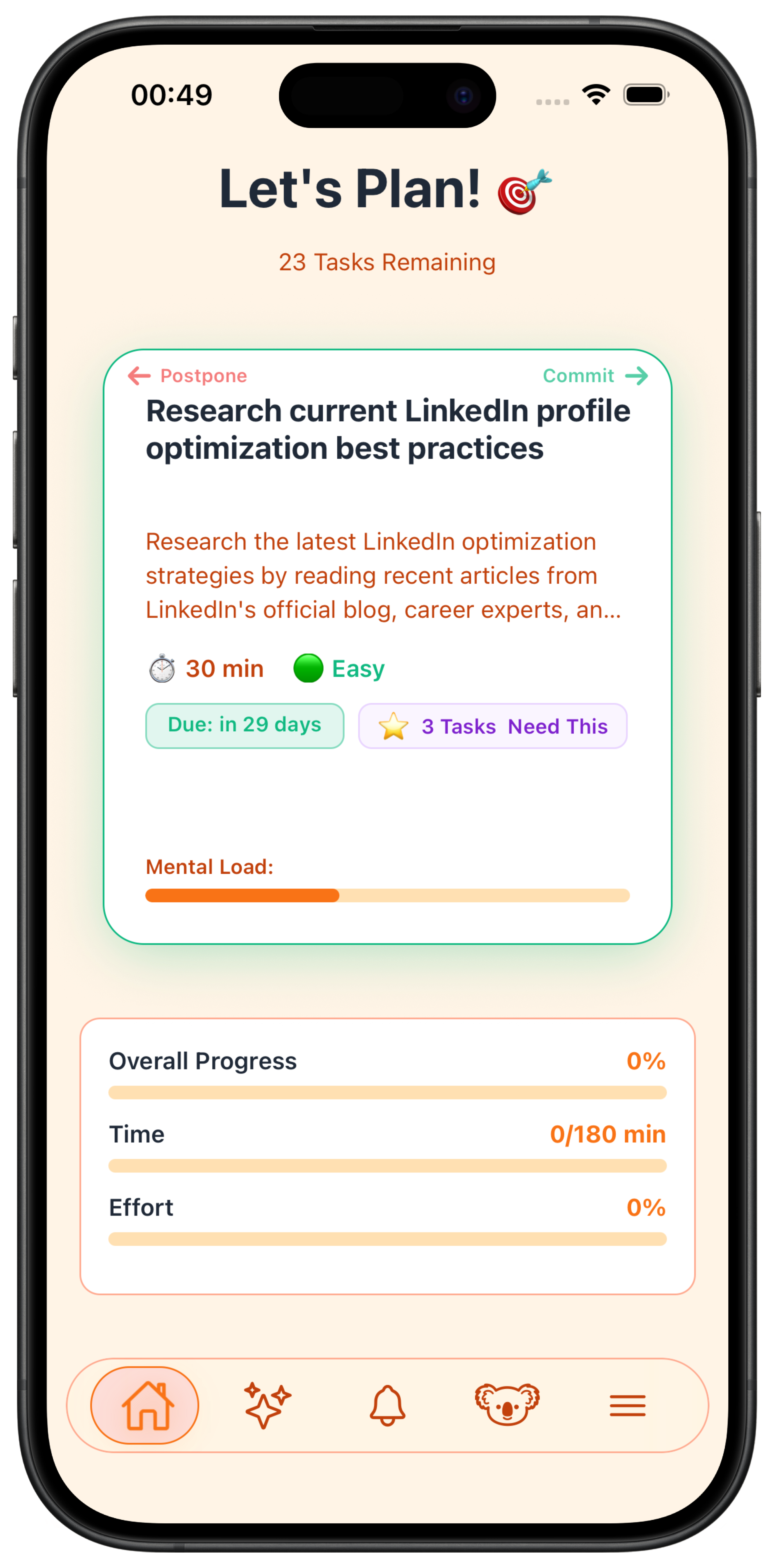
NoCrast’s customizable AI micro-tasking offloads planning from an underactive PFC. You set a maximum duration (for example, 5–15 minutes), and NoCrast’s AI generates a stack of micro-sprints from your bigger goals, so you are never staring at a vague “Write report” or “Clean apartment” with no idea where to start.
The morning swipe planning ritual then presents only a small, pre-filtered set of options. Swiping right to commit to 3–5 micro-tasks replaces heavy planning and prioritization with a fast, low-friction choice, which is easier for a PFC that struggles with complex decision-making.
Web Version
Mobile Version - Both iOS & Android
Dopamine Pathway Deficits
ADHD brains exhibit inefficient dopamine signaling in mesoaccumbens and mesolimbic pathways. PET imaging reveals lower D2/D3 receptor availability in the nucleus accumbens and faster dopamine clearance, tying inattention and “failure to launch” directly to reward‑motivation shortfalls.[10][2]
Because baseline dopamine is low, routine or predictable tasks (emails, chores, admin) do not generate enough stimulation to cross the “start” threshold. The brain compensates by seeking high-stimulation alternatives—novelty, deadlines, crises, or hyper‑interesting tasks—which is why many people with ADHD can hyperfocus at the last minute but cannot start early.[2][8]
How NoCrast Supports the Reward System
NoCrast’s progress rings and visual timeline are designed to give the brain frequent, small dopamine hits. When you swipe a task into today, its ring appears on your daily timeline. Completing that micro-task fills the ring to 100% immediately, providing a clear, visual “win” that your reward system can register, even for small, boring tasks.
Because you work in short, user‑defined micro-sprints (for example, 5–10 minutes), you accumulate more completions per day. Each completion is a mini reward event, which helps compensate for weaker dopamine signaling and gradually retrains the brain to associate task initiation and follow-through with positive feedback instead of only boredom or stress.
Emotional Dysregulation and Procrastination
ADHD does not only affect attention—it also affects emotion regulation. Research links ADHD to dysfunction in a network that includes the amygdala, ventral striatum, and orbitofrontal cortex, regions that process emotional stimuli and reward. This makes negative emotions around tasks—fear of failure, shame, overwhelm—more intense and harder to down‑regulate.[3][11]
Recent work also shows that poor control over thoughts and emotions mediates the link between attention problems and procrastination: mind‑wandering and emotional swings feed “I’ll do it later,” even when someone logically knows what to do.[4][12]
How NoCrast Calms Emotional Barriers
The dashboard view with overall progress and streak counters acts as an emotional anchor. Instead of only seeing what is unfinished, you see “4‑day streak” or “85% weekly progress,” which reframes your efforts in terms of consistency and capacity, reducing shame and all‑or‑nothing thinking.
NoCrast’s **mood‑aware AI assistant** (available when you choose to open the chat) lets you ask for help when emotions become a barrier: for example, “Low energy today,” or “This task feels scary.” The assistant can then suggest lighter micro-tasks, adjust the plan, or help you commit only to what fits your current mood and energy. This targeted support acknowledges that emotional state changes across the day and helps you keep moving without forcing you through maximum‑effort tasks when your nervous system is already overloaded.
How NoCrast.app Brings It All Together
NoCrast counters ADHD procrastination via 4 interconnected systems that map directly onto these brain differences: customizable AI micro-tasking, morning swipe planning, dashboard streak tracking, and on‑demand AI chat support.
1. Customizable AI Micro-Tasking (Bypasses PFC Overload)
You set your max duration (for example, 5–15 minutes), and NoCrast’s AI generates a personalized micro-sprint stack from your bigger goals. This replaces “figure out the plan” (hard for an underactive PFC) with a ready-made list of small, concrete actions you can choose from quickly.
2. Progress Rings + Visual Timeline (Dopamine Reinforcement)
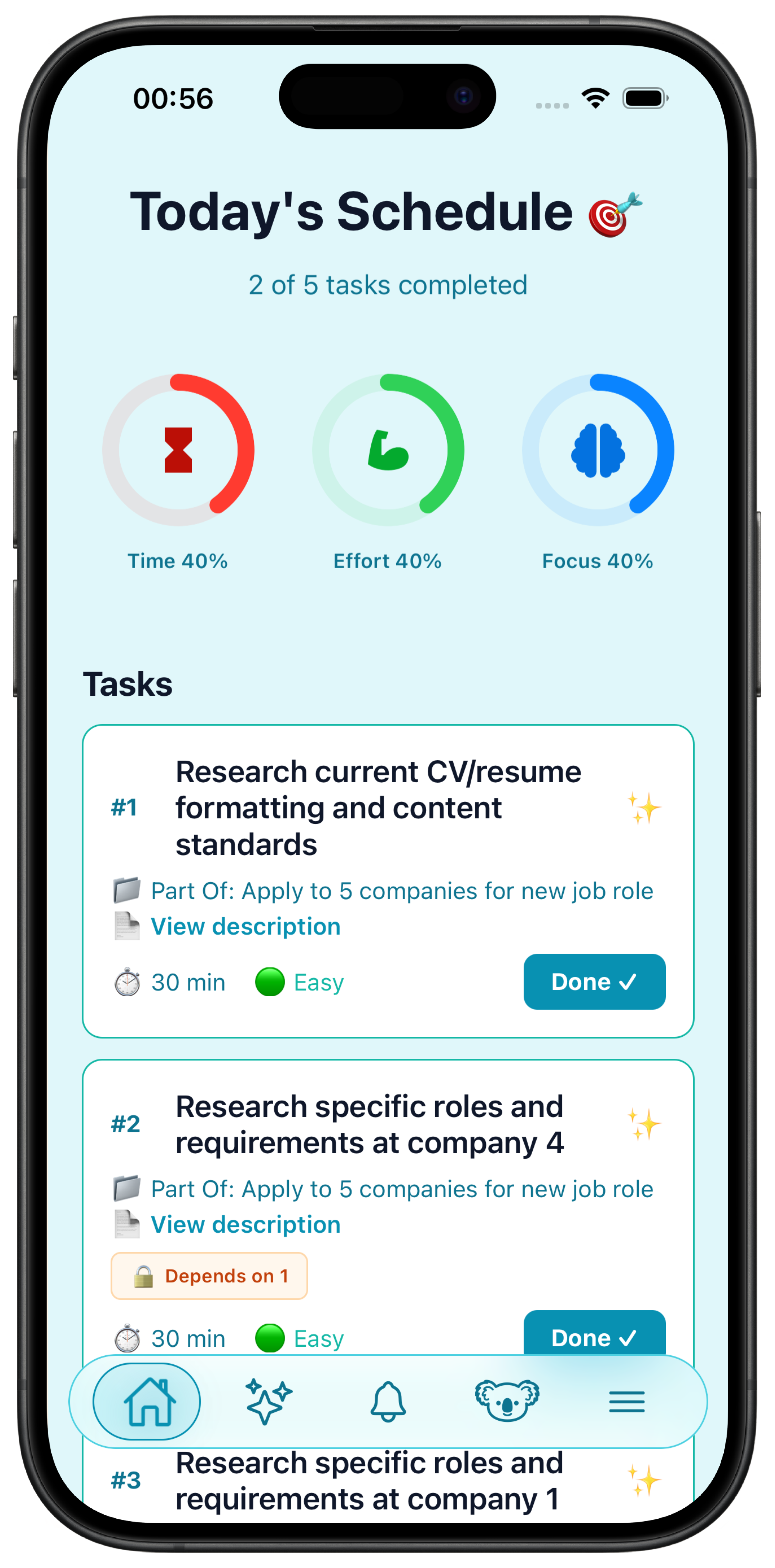
When you swipe right on a task for today, a ring appears on your visual timeline. As you complete tasks, rings fill instantly, so your brain gets a clear, repeated signal: “You did something; it counted.” Over time, this helps retrain your reward system to value small steps and see boring tasks as worth starting.
3. Dashboard Streak Counters (Long-Term Habit Formation)
The dashboard shows overall progress and streaks (for example, 3‑day, 7‑day, 30‑day). Seeing a streak stay alive provides ongoing motivation even on low‑energy days, nudging you to complete just one or two micro-tasks to “keep the streak,” which is much easier than trying to be perfect every day.
4. Mood-Based AI Chat Assistant (Contextual Emotional Support)
When your emotional state is the main barrier—fatigue, anxiety, low motivation—you can open the AI assistant and explain how you feel. It can suggest smaller tasks, help set reminders, or reorder your day around your current energy instead of pushing you into burnout. This dynamic adaptation respects ADHD emotional variability and gives you a low‑pressure way to keep moving forward.
Complete NoCrast Workflow
Setup: Choose “Max 10‑minute tasks” → Morning: AI stack appears based on your goals.
- Swipe right on “Open project doc (8 min)” and “Draft 3 bullet points (7 min)” → Rings appear on your timeline.
- Complete “Open doc” → Ring fills → brain gets a quick reward instead of only seeing a giant unfinished project.
- Energy dips → You open AI chat: “I’m tired, what’s the smallest step I can do?” → It suggests a lighter 5‑minute micro-task that still moves you forward.
Dashboard at the end of the week: “4‑day streak ✅ | 85% weekly capacity used” → you see consistent progress, not failure, which makes it easier to come back again tomorrow.
Download NoCrast.app: Set your micro-sprint limit → Swipe a realistic stack each morning → Let rings and streaks show your brain that small steps truly count → Use AI support when emotions get loud → Gradually rewire the systems behind ADHD procrastination, one day at a time.