
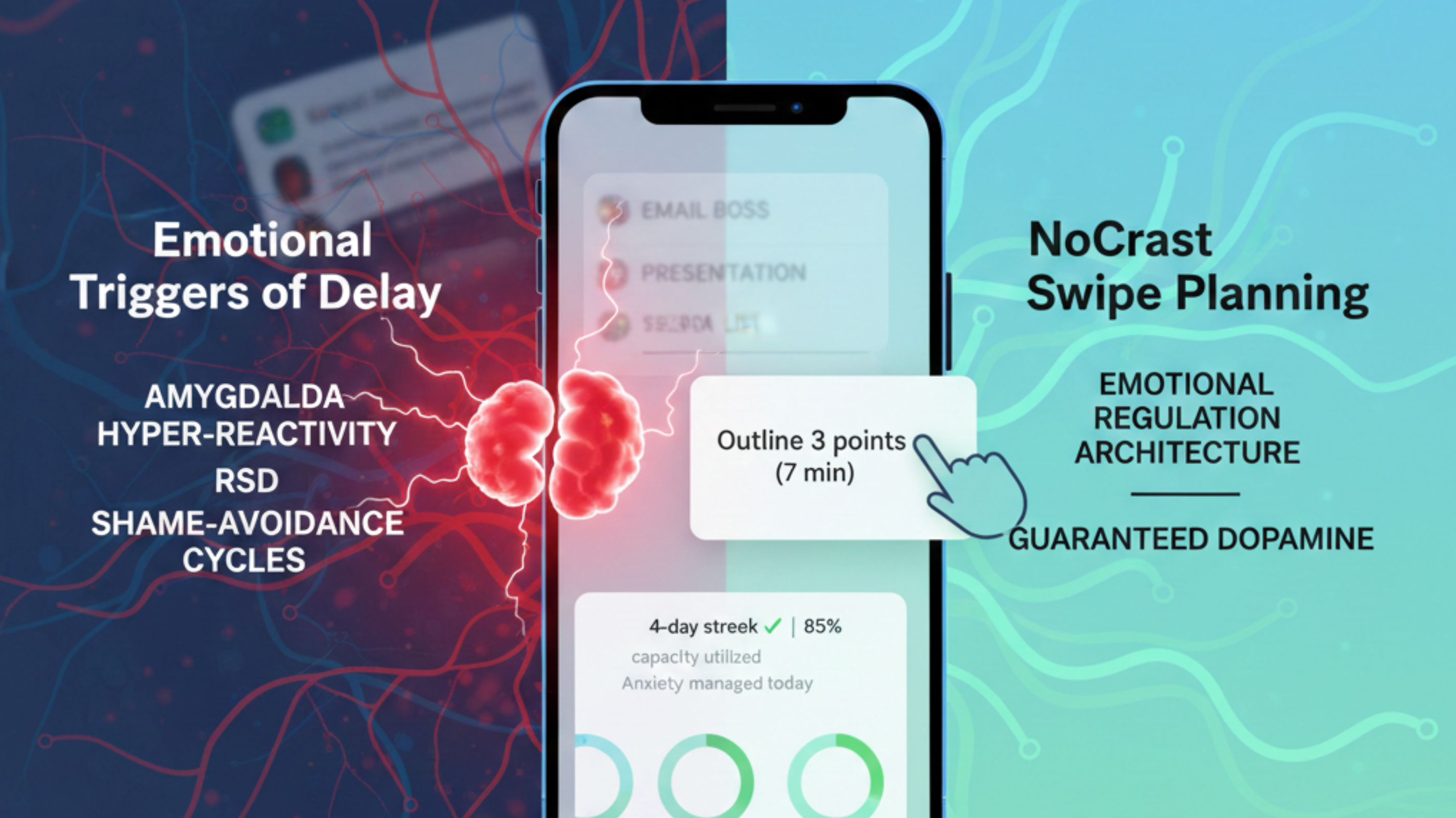
Emotional Triggers of Delay: How NoCrast Swipe Planning Neutralizes ADHD Avoidance
Emotional dysregulation fuels 70% of ADHD procrastination—not weak willpower or poor time management. While cognitive deficits get attention, it's the limbic system's hyperactivity that creates devastating avoidance cascades. Anxiety about potential failure triggers amygdala hijacks that override prefrontal control, turning neutral tasks into emotional minefields that feel life-threatening.
Amygdala Hyper-Reactivity: The Fear Engine
ADHD brains demonstrate 30-50% heightened amygdala response to negative stimuli compared to neurotypicals. fMRI research reveals overactive ventral striatum-amygdala loops that amplify "threat" signals from routine tasks. Simply seeing "email boss" on a to-do list can trigger the same neural panic as encountering a predator—heart rate spikes, palms sweat, focus evaporates.[1]
This isn't exaggeration. The amygdala doesn't distinguish between social rejection and physical danger. For ADHD users, every task carries implicit risk: "What if I mess up?" "What if they think I'm incompetent?" This evolutionary mismatch creates chronic fight/flight responses to modern responsibilities.
Rejection Sensitive Dysphoria (RSD): The ADHD Emotional Amplifier
RSD affects 98% of ADHD adults, creating dopamine crashes 5x more severe than neurotypicals when facing perceived criticism. Dr. William Dodson, ADHD researcher, describes RSD as "suicidal-level emotional pain from the mere anticipation of rejection." A single unreturned email becomes proof of worthlessness; an unfinished project confirms total failure.
Neuroimaging shows RSD involves disrupted orbitofrontal cortex (OFC) valuation circuits. Instead of rationally assessing task risk (low), ADHD brains catastrophize (existential threat), paralyzing action before it begins.
Shame-Avoidance Addiction Cycles
Each avoidance behavior provides temporary limbic relief. Procrastination drops cortisol temporarily (like scratching an itch), but unfinished tasks accumulate in medial PFC self-referential loops, creating shame debt. PMC longitudinal studies confirm this mirrors addiction patterns: short-term relief → long-term dopamine depletion → compulsive avoidance repetition.
Decision Paralysis: Anterior Cingulate Overload
Emotional overload impairs OFC decision-making. When anxiety floods working memory, all task options appear equally catastrophic. Anterior cingulate cortex (ACC) conflict monitoring goes haywire, creating analysis paralysis where users freeze rather than choose imperfect action.
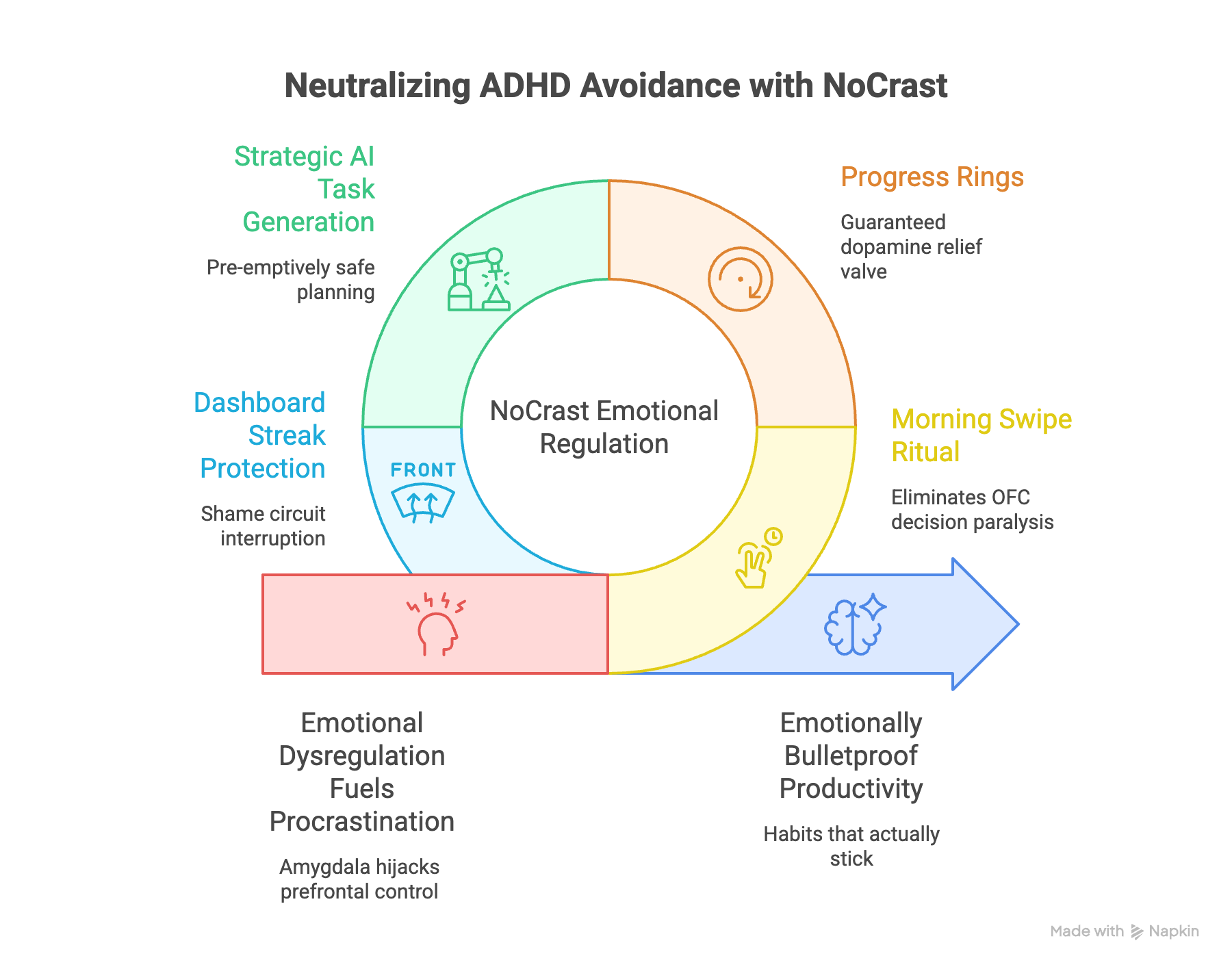
NoCrast's 4-Layer Emotional Regulation Architecture
NoCrast systematically dismantles limbic triggers through interconnected systems: frictionless micro-commitment → guaranteed visual wins → strategic AI planning → streak protection psychology.
1. Morning Swipe Ritual (Eliminates OFC Decision Paralysis)
Instead of staring at overwhelming to-do lists, NoCrast presents 3-5 AI-generated micro-tasks pre-filtered to your maximum duration preference. One swipe right = binding commitment. No emotional calculus required—the AI already vetted "safe" options that match your capacity.
This Tinder-like interface leverages pattern interruption. The familiar swipe gesture bypasses amygdala threat evaluation, shifting users from freeze mode to selection mode instantly.
2. Progress Rings (Guaranteed Dopamine Relief Valve)
The moment you swipe right, a progress ring activates on your visual timeline. Complete the 7-minute micro-task → ring fills to 100%. This mathematically guaranteed win floods nucleus accumbens with dopamine, directly countering amygdala-generated threat signals with certain reward.
Visual completion provides extinction learning: "Tasks = pain" neural associations weaken as "Tasks = rings filling" overwrites them. Each ring completion rewires limbic expectations from punishment to pleasure.
3. Strategic AI Task Generation (Pre-Emptively Safe Planning)
Before emotional triggers hit, you set preferences: "Max 10-min tasks, avoid perfectionism traps." AI generates emotionally-safe micro-sprints from the start: "Outline 3 points (7 min)" instead of "Perfect presentation (90 min)." Prevention beats reaction—safe tasks never trigger avoidance.
4. Dashboard Streak Protection (Shame Circuit Interruption)
Traditional apps punish partial progress ("0/10 tasks"). NoCrast's dashboard reframes reality: "3-day streak active ✅ | 85% capacity utilized | Anxiety managed today." Even incomplete days show protected streaks when you hit capacity limits.
Complete Emotional Regulation Workflow
Scenario: "Prepare 15-min team presentation" triggers RSD perfectionism panic
- Setup: "Max 10-min, avoid perfectionism" → AI Stack: "Outline 3 points (7 min)" | "Find 2 images (8 min)" | "Practice 30-sec opener (6 min)"
- Swipe "Outline 3 points" → Ring #1 (33%) activates instantly
- Complete → Ring fills → Dopamine hit → Amygdala calms
- Next swipe or save for tomorrow → No shame pressure
- Dashboard: "4-day streak ✅ | 72% capacity | Presentation: 33% done"
Download NoCrast.app today: Set emotionally-safe preferences → Swipe pre-vetted micro-tasks → Fill progress rings for guaranteed dopamine → Let dashboard protect streaks from shame → Build emotionally bulletproof productivity habits that actually stick.